
English| EUR
Suggested for you
More currencies
Choose a language
Few questions about Leonardo's portrait come up more often than whether it has ever left its Paris gallery. The short answer is yes — rarely, and not for a long time. This page sets out the confirmed journeys, the reasons behind the current no-loan position, and how that shapes a modern Louvre visit.
Quick answer
Yes — but only a handful of times, and not since 1974. The painting travelled to Washington and New York in 1963, then to Tokyo and Moscow in 1974. Since then the Louvre, at Musée du Louvre, 75001 Paris, France, has kept it in permanent display for conservation reasons, so a trip to Paris is the only reliable way to see it.
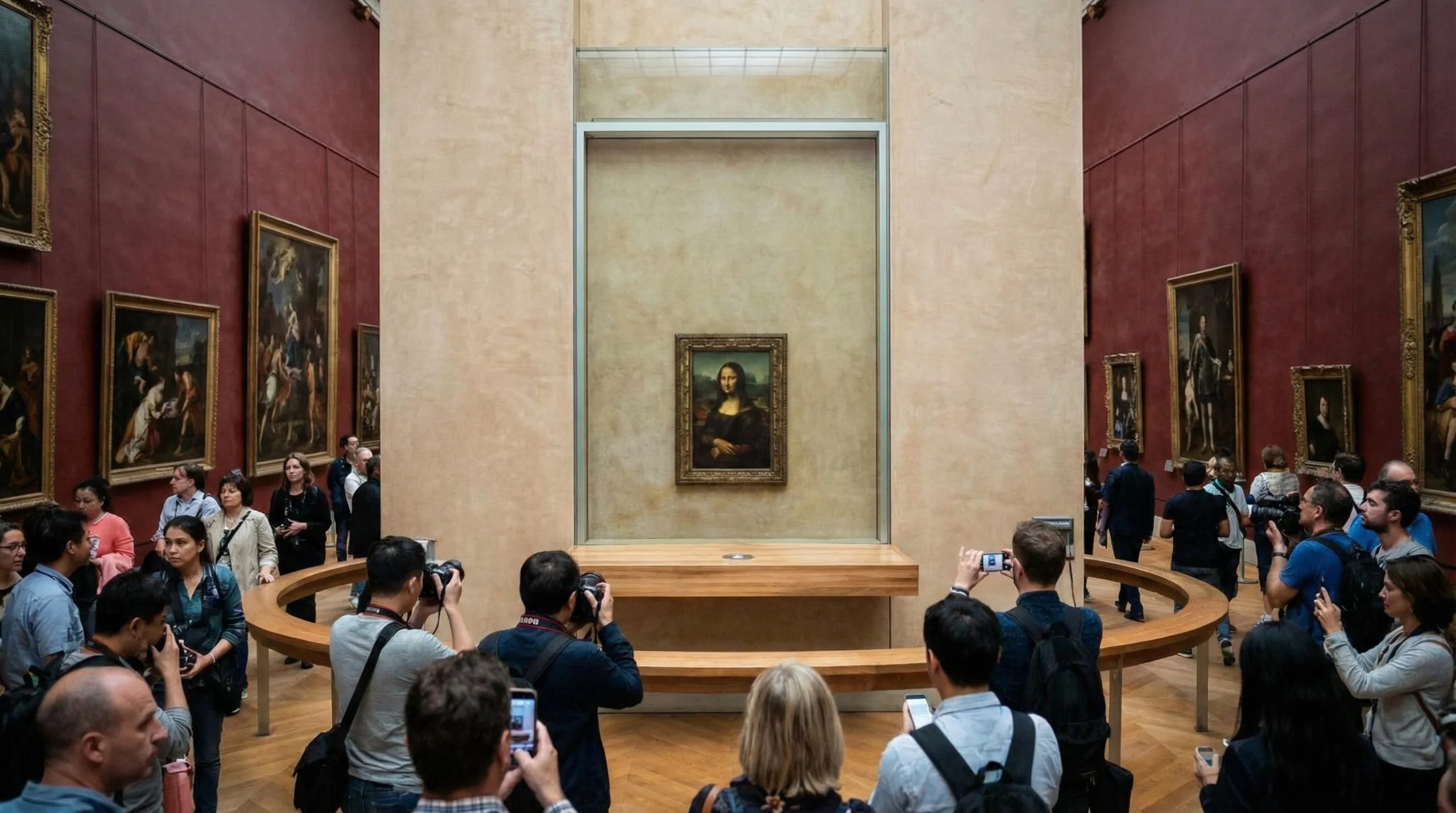
Leonardo da Vinci's panel is painted on poplar wood, not canvas, and that single material fact governs almost everything about its movement. Wood swells and contracts with humidity; a crack running down from the top edge has been monitored for centuries. When people ask has the mona lisa ever been on tour, the honest reply is that the journeys were exceptional diplomatic events rather than routine loans, and each one required a purpose-built climate case, naval or state transport, and a level of security more familiar to heads of state than to paintings. The travel record is short. In 1963 the portrait crossed the Atlantic for showings in Washington and New York, arranged through French cultural diplomacy. In 1974 it went east, to Tokyo and then Moscow. It has not left the building since. Today the panel hangs behind laminated glass in the Salle des États, the largest room in the Denon Wing, in a sealed case holding steady temperature and humidity. The Louvre's position is that the risks of transit now outweigh any exhibition benefit — a stance restated each time a foreign institution asks. Anyone booking a mona lisa guided tour is therefore booking a Paris visit, not chasing a travelling exhibition. What does this mean in practice? It means planning around one room rather than one object. The Salle des États also holds Veronese's Wedding at Cana on the opposite wall, and the Grande Galerie beyond it carries the rest of the Italian collection, so the walk from the Pyramid entrance through Denon rewards the visitor who paces it. Crowds cluster tightly at the barrier, and viewing time at the front is measured in seconds rather than minutes. Skip-the-line entry and a timed slot matter more here than at almost any other Paris landmark, and the Louvre's late evenings thin the room noticeably. So the question has the mona lisa ever been on tour resolves into a practical instruction: go to Paris, book ahead, and treat the Salle des États as a fixed appointment inside a much larger museum. The sections below cover the history in depth, the current opening pattern, entry costs and the quietest arrival windows.
“The journeys were exceptional diplomatic events, not routine loans — and none has happened since 1974.”
Leonardo da Vinci began the portrait around 1503 in Florence, and carried the panel with him to France in 1516 at the invitation of François I. The king acquired it for the royal collection at Fontainebleau, where it hung among the Italian pictures. Louis XIV moved it to Versailles in the 1690s. After the Revolution it entered the Louvre in 1797, and Napoleon Bonaparte kept it in his bedchamber at the Tuileries from 1800 until 1804, when it returned to the museum for good. So, has the mona lisa ever been on tour? Twice in the modern era, and both times under state pressure rather than curatorial enthusiasm. On 14 December 1962 the panel left Paris aboard the liner France, insured for a nominal 100 million dollars, after André Malraux agreed to lend it to Jacqueline Kennedy. It hung at the National Gallery of Art in Washington from 8 January 1963, then at the Metropolitan Museum of Art in New York, drawing some 1.7 million viewers before returning in March. In 1974 it travelled again, to the Tokyo National Museum and then, on the homeward leg, to the Pushkin Museum in Moscow. Nothing has been permitted since. The earlier absence was involuntary. On 21 August 1911 the Italian handyman Vincenzo Peruggia carried the panel out of the Salon Carré under his smock; it surfaced in Florence in December 1913. Wartime evacuations followed in 1939 and 1940, when the picture was shuttled between châteaux at Chambord, Loc-Dieu and Montauban. A 1956 acid attack and a 1974 incident in Tokyo hardened institutional resistance to travel, and the Louvre now cites the poplar panel's warp and its 1517 crack as grounds for refusal. Anyone weighing whether has the mona lisa ever been on tour should note what remains fixed on the site of these events. The Salle des États, refitted in 2005 and again in 2019, holds the portrait behind laminated glass in a climate-controlled case, on a freestanding wall opposite Veronese's Wedding at Cana. Visitors on a Paris landmarks route or a Louvre Museum tour still enter through the Cour Napoléon pyramid, completed in 1989.
Leonardo da Vinci begins the portrait in Florence.
Leonardo brings the panel to France at the invitation of François I.
The painting enters the Louvre's collection after the Revolution.
Vincenzo Peruggia steals the panel; it is recovered in Florence in 1913.
The portrait is evacuated to Chambord, Loc-Dieu and Montauban during the war.
The panel is exhibited in Washington and New York after a December 1962 Atlantic crossing.
Loans to the Tokyo National Museum and the Pushkin Museum in Moscow mark its last journeys abroad.
The Salle des États reopens after refitting, with the portrait in a climate-controlled case.
The Mona Lisa has rarely left the Louvre, serving primarily as a diplomatic instrument during its few international journeys. Today, the painting is classified as too fragile to be moved, ensuring it remains a permanent fixture in Paris.
At the request of First Lady Jacqueline Kennedy, the painting was transported to the United States for exhibitions at the National Gallery of Art and the Metropolitan Museum of Art. It traveled on the liner SS France with heightened security measures.
The painting was sent to Japan and the Soviet Union, marking its final international tour to date. The rigorous conditions required for these exhibitions led officials to conclude that the panel's physical state was too delicate for further travel.
International exhibitions of the Mona Lisa have historically been organized to strengthen political and cultural ties between nations. These movements were managed with military-grade security and specialized climate-controlled containers.
Conservation experts have determined that the poplar wood panel on which Leonardo da Vinci painted is prone to warping and cracking. Moving the painting risks structural damage, effectively grounding it at the Musée du Louvre permanently.
While not an international tour, the painting's 1911 theft by Vincenzo Peruggia brought it to global prominence. It was missing for two years, during which it was hidden in a trunk in Paris before being recovered in Italy.
Within the Salle des États at the Louvre, the painting is housed in a climate-controlled enclosure behind bulletproof glass. This technology maintains constant humidity and temperature levels to stabilize the aging wood panel.
The Louvre Museum maintains consistent weekly operating hours for visitors planning to view the permanent collection, including the Mona Lisa. The museum remains closed on Tuesdays.
Everything you need to know about has the mona lisa ever been on tour
While the painting has left the Louvre for specific historical events in the past—most notably trips to the United States in 1963 and Japan in 1974—it has the mona lisa ever been on tour in a modern sense is a common point of confusion. Today, the painting is permanently housed in the Salle des États and does not participate in traveling exhibitions. Many visitors wonder if has the mona lisa ever been on tour, but conservation experts maintain that the fragile wood panel is best preserved in a climate-controlled environment. The artwork remains in its display case to ensure its safety and longevity for future generations. Yes, you can view the painting during a professionally led Louvre guided tour. Engaging an expert guide is a popular way to explore the history of Leonardo da Vinci's work and navigate the crowded Salle des États efficiently. Exploring the painting as part of a structured Paris landmarks visit helps maximize your time within the museum. The Mona Lisa is not part of a traveling exhibition, as the Louvre treats the portrait as a permanent fixture of its collection. You will find it located in the Denon Wing, where it has remained stationary for decades despite public interest in temporary loans. When researching has the mona lisa ever been on tour, it is helpful to note that the museum prioritizes permanent display over international movement. To plan your visit, arrive during the recommended best arrival window of 09:00–17:00. The museum is closed on Tuesdays, so consider visiting on a Wednesday or Friday evening for quieter access to the galleries. Checking the official site for real-time updates ensures your trip is logistically sound. The standard adult entrance fee of 32 EUR provides access to the permanent collections, including the display area where the portrait is held. There are no additional fees or separate tickets required to see the painting once you have gained entry to the museum. Ensure you book your visit in advance to secure your spot at this iconic Paris landmark.